That’s just how far back the bond between football and education goes in Scotland. And over here at Scottish Academic Football, we spotlight that relationship. We explore the historical relationship between football and educational institutions in Scotland, while also looking at what that relationship has grown to become today.
Here are some of the key areas we’ll be covering:
The Growth of Organised Football in Scotland
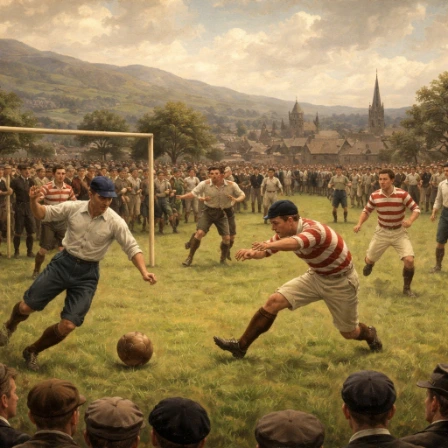
While football had already been a popular pastime in Scotland for centuries, it was the 19th century that brought a period of major transformation to the sport. This was when football began to move from a disorganised, localised recreation to a more organised and structured sport.
It was during this period that Queen's Park, founded in Glasgow in 1867, became one of the major pioneers of association football in the country. The Scottish Football Association was also established in 1873, followed by the Scottish Cup in 1874 and, later, the Scottish Football League in 1890. Together, these developments helped create the organised football structure that exists in Scotland today.
Schools and universities were, in fact, part of this wider transformation. Schoolmasters in places such as Edinburgh recognised that football could be more than just a pastime. It could encourage fitness, discipline, teamwork and a competitive spirit among students. And so, they deliberately encouraged the game within educational settings. And that contributed to football becoming more organised and structured, and eventually laid some of the foundations for the development of football clubs and associations in the country.
The Birth of University Football Clubs
The modern concept of an organised football club actually traces its roots back to an Edinburgh student. In December 1824, 17-year-old John Hope founded what is widely recognised as the world's first documented football organisation, simply named The Foot-Ball Club. The club went on to operate for 17 years and played more than 500 internal matches. Perhaps even more importantly, Hope penned the first known written rules of football in 1833, banning practices such as tripping and carrying the ball. And that, to a large extent, helped push the game towards the more structured style of football that would eventually become association football.
As football continued to become more organised, and association football became increasingly codified in the late 19th century, Scotland’s major universities also began formally establishing dedicated football clubs of their own. Edinburgh University AFC was founded in 1878 under the guidance of John Smith, while Glasgow University FC was also formed in the late 1870s.
And alongside Edinburgh, Glasgow University quickly grew into a prominent force within Scottish university football. In fact, the two universities famously competed in the third-ever Scottish Cup during the 1878/79 season. The influence of these early university clubs also extended beyond student competition. Glasgow University’s William Beveridge, for example, went on to earn three international caps for Scotland between 1879 and 1880.
University Football and The Scottish Wider Football Structure Today
University football in Scotland has evolved considerably since the 19th century, and has become the more organised, structured, and inclusive version we know today. However, football was not always accessible to everybody. For much of the 20th century, there was a degree of gender division in Scottish schools, with boys generally encouraged to play football while girls were more commonly directed towards sports such as netball and hockey.
The situation, however, began to change after the Scottish Football Association lifted its ban on women's football in 1974. Female students then started forming university teams, often with limited funding and access to facilities, but these early efforts gradually developed into established women's clubs and organised competitions.
Today, Scottish university football operates across two connected systems which include both men's and women's competition. Specifically, universities now compete in student competitions organised through British Universities and Colleges Sport (BUCS) and Scottish Student Sport (SSS). Some of the country's strongest university clubs also compete in the senior Scottish football pyramid.
Traditions That Still Shape Student Football Today
Student football in Scotland has changed considerably over the years, but many traditions established by its early clubs, club identity, organised competition, university rivalries, and links with the wider game are still very much noticeable in how the sport is played today.
University teams are still organised around student-led committees, with clubs managed through roles such as:
- Presidents
- Treasurers
- Secretaries
This is in place rather than simply operating as informal recreational teams. There is also a strong sense of continuity through historic competitions and rivalries.
For example, the oldest inter-city university rivalry in the world between the University of Edinburgh and the University of Glasgow is still very much alive today. The Queen’s Park Shield, first introduced in 1921 for Scotland’s ancient universities, is also still an important part of the student football calendar.
At Scottish Academic Football, we explore all of this history, from the earliest student clubs and university rivalries to the competitions and traditions that still exist today. Our goal is to continue to spotlight the relationship between football and education in Scotland.